Last updated August 2026
“It can’t be repaired” is sometimes true and sometimes lazy
You pick up a screw on Hilton Highway, drop the tyre in somewhere, and get told you need a new one. Sometimes that is correct and unavoidable. Sometimes it means the place you took it to does not do proper repairs and selling you a tyre is simpler.
★View the Best Tyre Shops in Timaru→Knowing which is which is worth a few hundred dollars, and the rules are not complicated. Here is what actually decides whether a tyre can be saved.
Start with the tread, because it decides everything else
There is no point repairing a tyre that is nearly finished.
New Zealand’s legal minimum tread depth is 1.5mm, and it has to be there right around the circumference within the principal grooves, across the central three-quarters of the tread. Below that, the tyre fails a Warrant of Fitness. NZTA’s inspection guidance sets out exactly how inspectors measure it.
The thing to understand is that 1.5mm is a legal floor, not a performance target. Wet-weather grip falls away well before you get there. Braking distances stretch out and aquaplaning risk climbs, and on the Canterbury plains in a southerly that is not academic. If a tyre is close to the limit, repairing it buys you a few months at reduced grip. Replacing it is usually the better call, and an honest shop will say so.
Where the damage is matters more than how big it is
This is the rule that decides most cases.
Tread area (the flat part that meets the road) is repairable. There is enough structure there to take a proper repair and the area does not flex much.
Sidewall (the flat vertical face) is not. The sidewall flexes constantly as the tyre rolls, so no repair will hold, and a patched sidewall can fail suddenly at speed. Any puncture, cut or bulge in the sidewall means a new tyre. That one is not negotiable, whoever you ask.
Shoulder (the curved zone between the two) is the grey area, and generally treated as not repairable for the same flexing reason.
So a nail straight through the middle of the tread is usually fine. A cut in the sidewall from a kerb or a bit of farm debris is not, no matter how small it looks.
Even in the tread there are limits. A large hole, a long gash, or a puncture that has gone in at a sharp angle and torn through more of the casing than the entry hole suggests can all take a tyre out of repairable territory.
Multiple repairs are a judgement call: how many the tyre already carries and how close together they are. And a puncture that overlaps an existing repair is done.
The damage you did after the puncture
The most common reason a genuinely repairable tyre gets written off is not the puncture. It is the drive home.
Running a tyre flat or badly under-inflated, even a short distance, destroys the internal structure. The sidewalls fold and grind against themselves and the casing breaks up on the inside where you cannot see it. The tyre can look completely normal from outside and be scrap. A shop will find it when they break the tyre down, which is one reason a proper repair involves taking the tyre off the rim and inspecting it inside rather than working from the outside.
Which is the argument for a roadside callout rather than limping into town on a flat.
Plugs versus proper repairs
A string plug pushed in from the outside is a get-you-home fix, not a repair. It does not seal the inner liner and does not address damage inside the casing.
A proper repair means the tyre comes off the rim, gets inspected internally, and the injury is repaired from the inside, typically a combined patch-plug that fills the hole and seals the liner. It takes longer and it lasts.
If someone repairs your tyre without taking it off the wheel, you have had a plug, whatever it was called on the invoice.
Vulcanising, and why it matters more out of town
For big tyres the maths changes completely. Replacing a tractor, truck or earthmover tyre is an expensive exercise and often involves waiting on stock, which for a farm or a contractor means downtime as well as cost.
Vulcanising is a repair process that uses heat, pressure and bonding materials to restore damaged tyres to a safe, usable condition. Done properly it is a permanent structural repair rather than a patch, and it is standard practice on agricultural, truck, trailer and heavy machinery tyres. Not every shop has the gear for it, which is why “it can’t be repaired” sometimes just means “not here”.
For anyone farming or running gear in South Canterbury, knowing there is vulcanising available locally is worth knowing before you need it.
Second-hand tyres, sometimes sensible, sometimes not
A good used tyre with plenty of tread can be a reasonable buy: a spare, an older vehicle you are running out, or matching a single damaged tyre to the ones already on the car. The important part is that it comes from somewhere that inspects what it sells rather than a pile behind a shed. Age, internal condition and previous repairs all matter and none of them are visible from the tread.
Rotation is the boring thing that actually saves money
Tyres wear unevenly. Front and rear do different jobs, and on most cars the fronts go first. Rotating them on a schedule spreads that wear and gets meaningfully more life out of a set. It is a cheap job that people skip and then pay for later.
Where Keen As Tyres fits
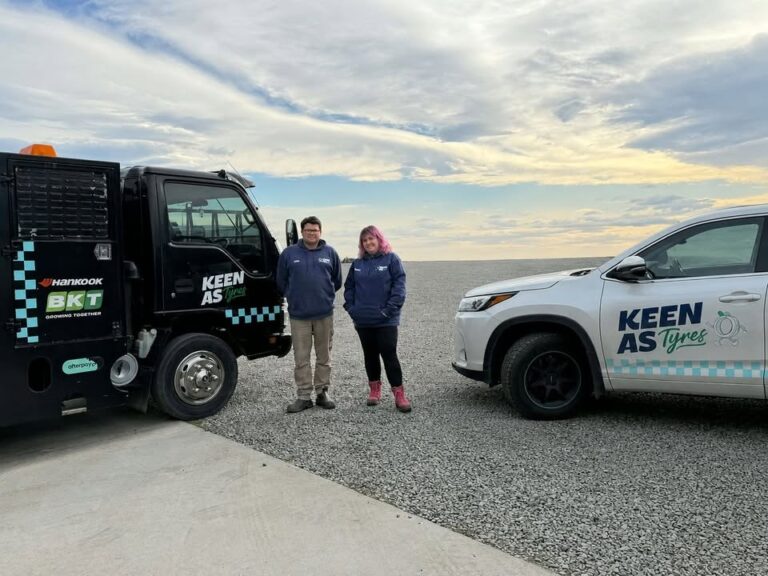
Keen As Tyres is a family-run business in Washdyke, servicing Timaru and across South Canterbury, the Mackenzie country, the Waitaki Valley and North Otago. Shaun brings more than 22 years in the tyre industry, with a particular focus on repairs, and Rachael runs bookings and the day-to-day.
They handle new tyres for cars, SUVs, 4WDs and light trucks, puncture repairs, and fleet, agricultural and commercial work including on-farm and roadside callouts, with 24/7 mobile support across the region. Rotation and balancing is $50 for standard passenger vehicles, or $100 where a TPMS reset is needed. They also do vulcanising in-house, which is the reason they can often save a tyre another shop has already written off.
Their full service list is on their site. If you have been told a tyre is beyond repair, it is worth a second opinion before you buy a new one.